



Workshops are moving away from mechanical key lockers. Why? They don’t meet modern needs like 24/7 access, payment integration, or security tracking.
Here’s the quick breakdown:
- Mechanical key lockers are simple, offline, and low-cost. However, they lack security, audit trails, and scalability. Codes are easy to share, and lost keys lead to expensive rekeying.
- Smart key lockers are connected, secure, and automated. They offer time-restricted PINs, remote management, and payment-triggered key release. They save time, reduce risks, and work across multiple locations.
Bottom Line: If you’re running a busy workshop, smart lockers solve the headaches of outdated systems while improving customer convenience and operational efficiency.
Quick Comparison
| Feature | Mechanical Lockers | Smart Lockers |
|---|---|---|
| Access | Shared PIN or physical key | Unique digital code per user |
| Security | Low (easy to bypass) | High (encrypted, designed for secure, monitored access) |
| Audit Trail | None | Full timestamped log |
| Access Revocation | Manual rekeying | Instant, remote |
| Payment Integration | No | Yes |
| Scalability | Limited (manual updates) | Centralized, cloud-based |
| Customer Convenience | Business hours only | 24/7 self-service |
Smart key lockers, paired with platforms like Autlio, fully automate key man
agement, from payment to pickup. They’re the future for workshops aiming to save time, improve security, and grow revenue.
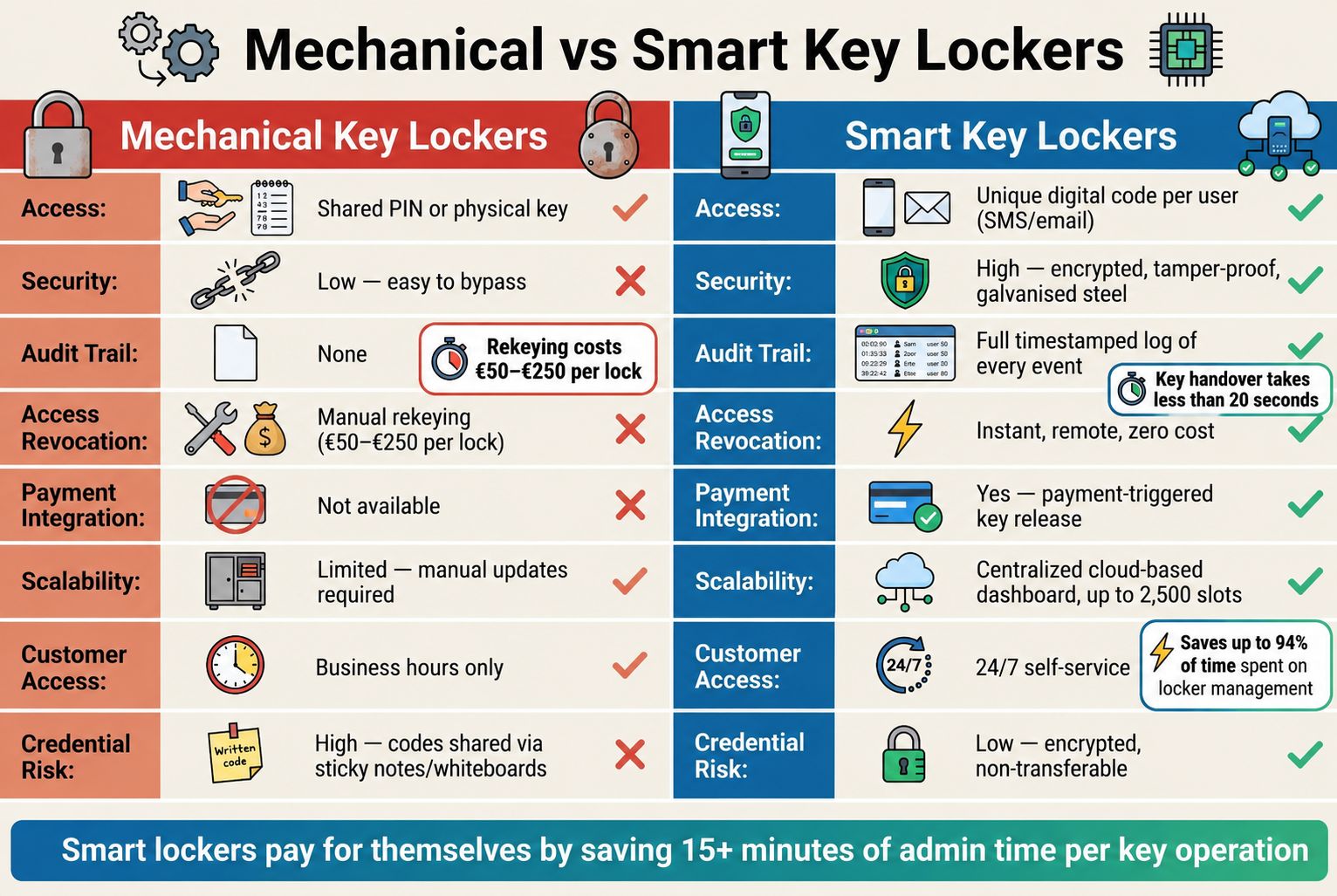 Mechanical vs Smart Key Lockers: Full Feature Comparison
Mechanical Key Lockers: How They Work and Where They Fall Short
Mechanical key lockers were once the go-to solution for workshops, but their limitations are becoming harder to ignore in today’s tech-driven world.
How Mechanical Key Lockers Work
The beauty of mechanical key lockers lies in their simplicity. Each compartment is secured with a combination or pin-tumbler lock. A staff member provides the customer with a code to access the locker. That’s it – no software, no power, no internet required. This makes them reliable during power outages and straightforward to operate. However, this simplicity comes at a cost.
Security and Compliance Risks
The same simplicity that makes mechanical lockers appealing also makes them vulnerable. With no digital safeguards, there’s no way to control or monitor who uses a code once it’s shared. Did someone jot it down? Share it with a friend? Use it more than once without permission? You’ll never know.
Even worse, mechanical lockers lack a digital audit trail. There’s no way to track who accessed a locker or when. For workshops managing customer vehicles – filled with sensitive personal data and valuable items – this is a huge risk under GDPR. Insurers are paying attention too. A security breach tied to an unmonitored mechanical system could lead to higher premiums or even denied claims.
Operational Inefficiencies
Mechanical lockers also struggle to keep up with the demands of a growing workshop. Everything from updating codes to tracking key usage is a manual process. Add more vehicles, more staff, or additional locations, and these systems quickly become unmanageable.
Here are some common headaches:
- Codes need constant manual updates.
- There’s no way to tie key access to completed payments.
- Checking the status of a vehicle requires a physical inspection, wasting time.
- Rekeying lock costs add up fast
For busy workshops, these inefficiencies can snowball into serious operational bottlenecks.
When Mechanical Lockers Still Make Sense
Despite their flaws, mechanical lockers aren’t entirely obsolete. They’re still a practical choice for low-traffic internal storage, like a small workshop used by a handful of trusted staff.
However, their usefulness ends where accountability and scalability begin. The moment customers are involved or proof of access is required, mechanical systems fall short. They simply can’t provide the control or transparency that modern workshops demand.
sbb-itb-d2f596d
Smart Key Lockers: Features, Benefits, and Workshop Applications
Smart key lockers address the limitations of traditional mechanical systems, offering a modern solution that boosts security and simplifies operations, especially for workshops managing multiple locations.
Core Features of Smart Key Lockers
These lockers use advanced technology to provide unique, time-restricted access codes sent directly via SMS. Customers receive an access code on their phone, while staff can securely access keys using personal credentials or mobile access. SMS-based access is simple, reliable, and does not require customers to install an app or monitor their email inbox. The system allows administrators to monitor locker usage, reassign slots, and revoke access in real time – no physical presence required. Designed for scalability, smart lockers can accommodate anywhere from a few slots to an unlimited number of lockers or key slots, depending on the workshop’s needs.
Security and Compliance
Every access event is automatically logged with timestamps, offering detailed records of locker activity – a feature mechanical systems can’t match. Built with galvanised steel, with proven reliability of the locks and end-to-end encryption, these lockers meet supported accountability and access logging requirements, addressing potential security and privacy concerns.
Customer Experience
Smart key lockers significantly improve convenience for customers. Instead of needing to coordinate key handovers during business hours, customers can drop off or pick up keys anytime – even during evenings or weekends – without requiring staff assistance. The process is quick and contactless, taking less than 20 seconds. Additionally, multilingual interfaces ensure customers and others can use the system effortlessly, making it ideal for walk-ins and after-hours visits.
Efficiency and Automation
Smart lockers streamline operations by automating tasks that would otherwise require manual effort. Unlike mechanical systems, they remove the need for manual code updates, physical key tracking, and front-desk delays. Technicians receive instant notifications when a vehicle is ready, allowing them to proceed without interruptions. Studies show that smart locker technology can save up to 94% of the time typically spent managing traditional locker systems. For workshops with multiple locations, a centralised dashboard eliminates the need for on-site visits to manage access or check locker status, simplifying what could otherwise be a logistical challenge.
Mechanical vs Smart Key Lockers: A Direct Comparison
Security and Shared Code Risks
Mechanical lockers depend on shared PINs or physical keys. Once these credentials are shared, controlling access becomes nearly impossible. For example, codes often end up written on sticky notes, whiteboards, or remain unchanged even after staff turnover. In contrast, smart lockers allow access to be revoked instantly and at no cost, eliminating the need for manual rekeying.
Accountability and Audit Trails
Mechanical lockers provide no way to track access. If a vehicle key goes missing or a customer disputes a handover, there’s no record to refer to. On the other hand, smart lockers automatically log every access event, complete with timestamps.
| Feature | Mechanical Locker | Smart Locker |
|---|---|---|
| Access credential | Shared PIN or physical key | Unique digital code per user |
| Audit trail | None | Full timestamped log of every event |
| Access revocation | Manual rekeying | Instant, remote revocation without cost |
| Credential exposure risk | High (sticky notes, whiteboards) | Low (encrypted, non-transferable) |
The differences between these systems go beyond security, influencing customer satisfaction and revenue generation.
Customer Experience and Revenue
Mechanical lockers limit key handovers to business hours. If a customer wants to drop off their car early in the morning or pick up keys late in the evening, someone must be available – or the appointment doesn’t happen. This limitation can lead to missed opportunities and lost income for workshops.
Smart lockers, however, provide 24/7 self-service access. Customers receive a code via SMS, enabling them to drop off or pick up keys without staff involvement. This convenience improves the customer experience and allows for after-hours bookings, turning the locker into a tool for generating passive income.
"Key handover and collection was the biggest bottleneck for us. Clients are not always able to come during working hours or wait in line at the counter. Autlio’s smart key locker made the entire process seamless – the client can drop off and pick up the car exactly when it suits them. This is a win for both the client and our team." – BM Auto – BMW car workshop
Scaling Across Multiple Locations
Scalability is another key distinction, especially for multi-site operations. Mechanical systems require on-site code changes and lack centralised control, making them costly to scale. Smart lockers, managed through a single dashboard, allow remote management across various locations.
Which Solution Fits Which Use Case
The choice between these systems depends on your operational needs. Mechanical lockers are only suitable for basic internal storage where a small trusted team needs occasional access. They are not recommended for unattended customer handovers due to shared code risks and lack of accountability.
Smart lockers are ideal for workshops managing unattended customer workflows, key handovers across shifts, or automated processes. With features like enhanced security, detailed audit trails, and seamless scalability, they enable workshops to offer more to their customers while streamlining operations.
Autlio: The Automation Layer for Smart Key Lockers
As workshops move away from outdated mechanical systems, Autlio steps in to fully automate smart key lockers. Autlio provides smart lockers that connect to your payment system, workshop software, and team, creating a seamless and automated key handover process.
Payment-Triggered Key Release
Here’s how it works: a customer’s keys are only released once their payment is confirmed. After a technician finalises the repair cost in the Dealer Management System (DMS), Autlio sends a pay by link to the customer via SMS. The customer can then pay using their preferred method – card, Google Pay, Apple Pay, invoice, or instalments. Once payment is completed, the system generates a unique pickup PIN and sends it directly to their phone.
This eliminates the need for staff to follow up on payments or worry about vehicles leaving before payment is secured.
With this setup, workshops can operate beyond regular business hours without adding extra shifts. Customers can drop off and pick up their keys at any time, while the workshop ensures full payment is received before the key locker opens. Autlio’s payment-triggered system integrates effortlessly with existing workshop software.
Integration with Workshop Software
Autlio acts as the link between the physical locker hardware and the software tools workshops already rely on. It integrates with Automaster (DMS), Montonio (payments), Dokobit (digital signatures), and Teltonika (IoT tracking), creating a fully automated flow that connects job status, billing, and key access.
This integration eliminates manual tasks like sending payment links, waiting for confirmations, or making follow-up calls. Each step triggers the next automatically. As Founder of Autlio Kenno Kink notes:
"By saving just 15 minutes of admin time per key operation, the system pays for itself rapidly through reduced labour costs."
For busy workshops, these time savings can quickly add up. Many see a return on investment within the first year of implementing Autlio. Beyond efficiency, this integration also simplifies management for workshops with multiple locations.
Managing Multiple Workshop Locations
For workshop groups with several branches, Autlio offers centralised, cloud-based management. A single dashboard allows managers to monitor key movements, activity, and audit trails across all locations remotely.
Access is role-based, meaning each staff member only sees tasks relevant to their role. New branches can even be added remotely, avoiding the need for costly on-site server installations or manual setup.
Conclusion
Key Takeaways
Mechanical key lockers may have served their purpose in the past, but they no longer meet the needs of modern workshops. They lack digital audit trails, accountability features, and payment integration, making them impractical for today’s demands. As Autlio states:
"The single biggest hidden cost [of mechanical keys] is the cumulative expense of rekeying locks."
Rekeying locks isn’t just a hassle – it’s a recurring expense that adds up over time, quietly draining resources.
Smart key lockers solve these issues by offering features like digital audit trails, instant access revocation, PIN self-service, and 24/7 availability. These capabilities align with what workshop managers and customers expect today. The results? Workshops report a 35% reduction in asset loss and save time on every key-related task. With such clear advantages, it’s time to move beyond outdated systems and embrace smarter solutions.
Next Steps
Autlio brings together smart locker hardware, payment systems, and workshop software into one seamless, automated workflow. Whether you manage a single workshop or multiple branches, the platform offers centralised control without unnecessary complexity. Sticking to shared codes and paper logs only widens the gap between your operations and the expectations of modern customers.
Discover how Autlio can transform your key handover process – and take control of your workshop’s operations, on your schedule, not your opening hours.
FAQs
How do smart key lockers work during a power or internet outage?
Smart key lockers can continue operating during internet disruptions by using mobile data connections instead of relying only on local wired internet. Optional battery backup or solar power can also be added for locations without fixed cabling or during temporary power outages. In addition, the lockers include a manual opening option if needed for emergency access or maintenance situations.
What do I need to integrate payment-triggered key pickup?
To enable payment-triggered key pickup with Autlio, you only need an active Montonio payment account connected to your smart key locker system. Payments go directly to your company account, and once the payment is confirmed, the customer automatically receives access to collect their keys. The setup takes only a few clicks and does not require complex workshop software or custom integrations to get started.
How hard is it to roll out smart key lockers across multiple workshop locations?
Rolling out smart key lockers across multiple workshop locations is a hassle-free process when using systems that are built to scale. With features like remote access, digital audit trails, and integration with workshop software, managing these lockers becomes highly efficient.
The initial setup focuses on configuring the software and setting up user access, but the systems are built to expand easily as your needs grow. Plus, remote management through web or mobile interfaces eliminates much of the need for on-site adjustments, streamlining the entire implementation process.